Showing posts with label family. Show all posts

Friday, June 6, 2014

Work for family-minded women

By Mary C. Tillotson

Image by Plaid for Women
A few years ago, a nearly-finished homeschool mom (her youngest was in high school) ran across this article, The Bride who was Groomed for a Career, and it sparked a conversation among her nearly-finished homeschooling friends. They had all given their daughters a solid education and grounding in faith and morals, but had they taught them the skills they’d need to be wives and mothers?


At the time, I didn’t know that mom (or my opinion) well enough to say anything much, but it’s been on my mind for a while. When I was in college, I hardly felt like I had any direction, career or otherwise – college was just what you did after high school.

I turned this question over at length with my women friends in college. One friend was thinking about law school, but didn’t see the purpose in getting a law degree if she was just going to get married, get pregnant, quit being a lawyer, and homeschool her kids. She’s been out of college for a few years now and has a great career in a different field, but (as far as I know) no marriage prospects. She seems happy. Other women set out to find and follow their career passion, knowing that if they got married and had kids, they’d give it all up, but at least for now they might as well pursue their passions. Other women studied in the classic liberal-arts way, majoring in some higher-things-oriented field without thinking about careers. Of those, the ones who aren’t moms are teachers. Other women didn’t finish college because they got married and pregnant before graduation.

I graduated, worked as a small-town reporter for a year, got married, spent the next year doing odd jobs to make ends meet, and now I’m back in journalism, and I’m not (at the moment) raising kids. I think I’m finally starting to find answers.

My advice to family-minded female college students?

Be aware that there are plenty of unknowns. You might dream of being a homeschool mom of many but never find a man you want to marry; you might dream of an awesome political career but unexpectedly meet the man you really want to raise kids with. You might marry and realize you and your husband aren’t able to conceive children, temporarily or permanently.

I have anecdotal evidence from talking to my friends and statistical evidence from seeing polls: a majority of mothers want to work part-time in some professional field. A few want to work full-time and a few don’t want to work professionally at all, but most want to keep being professional while reserving most of the day for their kids.

When you’re in college, I think it makes sense to do what you love and pursue a career in that field. Keep in mind the usual factors like how much the field pays, whether jobs are available in that field, whether you’ll have to go to grad school (and if it’s worth the time/money), etc., but also consider how flexible that field can be. If you’re a journalist or writer, it’s very easy to do that full-time or part-time. Teaching can go part time pretty easily too. Other fields don’t flex into part-time near as easily. I don’t mean you should avoid them; I do mean you should think about that.

Do you have the skills it takes to raise kids and keep house? I don’t think this should be a big concern. A mom of six with two in diapers told me no matter how prepared you are for motherhood, you make 90 percent of it up on the spot. I suppose it might help to have enough exposure to kids that you aren’t afraid of them, but from everything I’ve seen, taking care of babies is hard work but not complicated. As they get older you get wiser and read more books and talk to more people about it; I don’t see how a lot of pre-marriage preparation would be helpful. The rest of keeping house is mostly cooking, cleaning, and paying bills – none of that is hard to learn, and anyway I think men and women ought to have these basic skills before college.

I know a lot of you readers have different experiences than I have. Some of you are moms, some of you are single, some of you are in college, some have careers and some don’t. What do you think about all this?


Wednesday, June 4, 2014

Film Review: Mostly Martha - A Feast of Love

By Emina Melonic
Illumination; The Magic Lantern

Displaying MostlyMartha Poster.jpgMartha Klein is a chef.  Not just any kind of chef.  Cooking is an art form – it involves precision, perfection, beauty, and naturally, exquisite taste.  She is a chef at an upscale restaurant and she lives in an absolute certainty of what a meal should look and taste like, down to the degrees and minutes it takes to make foie gras, for instance.  Martha is in control and lives in a world whose center is a seamlessly presentable and delicately tasty plate of food.  But, this control vanishes in an instant when her sister is killed in an automobile accident.  Martha’s niece, an 8-year-old girl Lina, miraculously survives and for the time being, begins to live with Martha.  The chef begins to lose any sense of reality and the world she has created.
Mostly Martha (2001, German title Bella Martha) is a film directed by Sandra Nettelbeck, and the role of Martha is played Martina Gedeck.  Among other things, Gedeck is known for her intense role in The Lives of Others (2006) and she brings same intensity to the role of Martha – a combination of both stoicism and vulnerability.  Maxime Foerste brings a feeling of a suddenly motherless child into the foreground as both she and Martha are trying to make sense of the absurd situation.

Friday, May 16, 2014

"Go play!"

By Mary C. Tillotson

When my grandma died this spring, I felt like something had unraveled. She had been a kind of locus of unity in my extended family – she was how we were all connected. She was widowed a few months before I was born, so in my experience, she always stood alone as the pinnacle of the family tree. There was Grandma, then her three children and their spouses, and then us twelve grandkids. We would all go to visit Grandma, and we would all be together. Then she died, and I felt unstable, somehow. Would we all just drift, like astronauts untethered from their spaceship?

Grandma must have foreseen this, because she made sure it wouldn’t happen.

Caroline, Anne, Mary, Ellen:
The CAME club at my 2012 wedding shower.
They were my bridesmaids.
My family (two boys and three girls) lived about 20 minutes from her, and my Michigan cousins (four girls) lived within a couple hours, so we visited several times a year. The four of us little girls formed the CAME club, the best word our initials would spell. We ate ice cream out of little plastic cups and tried to turn them into toy boats to float down the river. Inspired by the paintings on her wall (which she’d painted) we held art contests in her basement, drawing sunsets with colored pencils on copy paper. We went for walks around her block. We ate the M&Ms, lemon candies, and pink candies she left in dishes around the house. We played house and fort and boarding school, crawling through the cupboards under the basement stairs and climbing over the wooden fence in the backyard, fortressed by a protective pine tree.

I still don’t know what the big kids did, other than exclude us, but we weren’t big kids and they weren’t little kids, and nobody seemed to mind. But there was another problem: our southern Indiana cousins. All three were boys, and two were little kids. We saw them once a year, for a few days just after Christmas, and we mostly avoided them. We didn’t know them, and they were boys. Plus, the initials of their first names – the two younger ones, I mean – spelled B.M. Ew!

Grandma had been close to her cousins when she was a kid, and she wanted the same for her grandkids. When the oldest was about 14 or 15 and the youngest was 3 or 4, she rented a lodge on Houghton Lake in northern Michigan, the beginning of a fifteen-year tradition. It was a two-hour drive for us Michiganders and a day-long trip for the Indiana family. We arrived, unpacked, and ran around doing kid stuff. The twelve of us grandkids fell fairly naturally into the six big kids and six little kids – some parent told the CAME Club we had to let the younger boys (B. and M.) play with us, and after some adjustment we found a way to fit them in.

A handful of us taking the boat out.
We spent the week doing all the things you’d expect from kids at a big lodge on a beach. We played hide-and-seek and capture-the-flag. We played water football and went tubing behind my uncle’s motor boat, affectionately named after my late grandpa. We drove into town to buy rubber band guns and suction-cup bow-and-arrow sets at the Indian store, then yarn and beads at the craft store. We rode the rusty old bikes to the park for tennis and the playground. We opened wintergreen leaves to smell them. We fought over who got to sleep in which room upstairs. One year we made chalk out of eggshells; another year we decorated popsicle-stick picture frames with glitter and buttons. The Mountain Dew flowed freely and we never ran out of Doritos. Our parents took lots of pictures.

Grandma wasn’t bubbly or extroverted. She would do crafts with us (the photo of all twelve grandkids standing in age order has been on her fridge for years, in the handmade popsicle-stick frame) and she would sit on the beach chatting with my mom and aunts, drinking something we weren’t allowed to try. Mostly, though, I think she enjoyed watching all of us be kids together. Then we were teenagers together. Then we started getting summer jobs and couldn’t take a week off, so while our parents stayed the whole week, we’d be in and out as we could make it. Finally, the youngest cousins were in college and the oldest ones were working entry-level jobs with no vacation time. Grandma had an empty nest.
Six little kids and Grandma at Houghton Lake, 2011

Almost three years after the last Houghton Lake week, Grandma died. Her grandkids were scattered all over the eastern half of the country. Four spouses and four children – one of them newborn – had been added to the family. But all twelve of us returned to our parents’ hometown in southern Michigan for the funeral. We hugged and cried and then went back to her house to be together. It was the first time we’d all been together in three or four years, and it was the last time we’d all be together at Grandma’s house.

The six little kids – now mostly grown up, with the youngest in college – were playing cards while trying to assign the responsibility of buying the lodge at Houghton Lake when my cousin David came into the room with a serious look on his face.

“Guys, we need to make some promises,” he said. “We always have to love each other, and we have to stay in touch.”

We all agreed, but the room was too merry (in that way reunions are) to consider them with the gravity David had intended. But we didn’t need to. All of that was an unspoken given – including buying the lodge, though it will be years before that’s a possibility. Grandma had wanted all of us to be friends, and she made it happen. Her tactic was simple. She took us all to the beach and said, “Go play.”

And we did.


Tuesday, May 13, 2014

Mothers Day: Sadly, Overcommercialized

By Joy Pullmann

I do not like to receive gifts for Mother's Day or Valentine's Day. And don't even think about Sweetheart's Day or whatever else they're calling further additions to the list of "buy crap no one wants because commercials made you feel guilty."

Mother's Day advertisements on my Kindle and email sidebars began a solid three weeks before Mother's Day. It may have been four weeks. Whatever it was, it was indecent. Mother's Day is not even on the A-list of holidays. That, for me, includes Easter, Thanksgiving, and Christmas. And maybe the Fourth of July. Those would be the top two Christian holidays and the top two American holidays. (By the way, President's Day and Labor Day are also stupid.)

Friday, April 4, 2014

Marriage Doesn't Have to Be Hard

By Brittany Makely
Guest Contributor

Everyone who is engaged or married has heard the warning – Be prepared. Marriage is hard. Maybe that’s true, but can someone please tell me what stage of life or life-altering decision does not include a challenge? It seems like too many people (intentionally or not) paint a picture of marriage as a toilsome, yet worthwhile, endeavor. Let’s be honest, being single is often at least as toilsome as being married. Staying in school and graduating takes roughly 18 years of focused, often-hard work. Succeeding in the professional world requires dedicated effort.

I’m not necessarily saying that marriage is or should be easy. What I am saying is that I think the seemingly inevitable “Oh, marriage takes a lot of hard work” from all the aunts at your bridal shower, coupled with those knowing nods and glances sends the wrong message. On some level, the fact that our society continues to proliferate this line about marriage contributes to a cheapening of the permanence of the institution. Part of what got us to a point in our nation where no-fault divorces are as common and accepted as corner coffeeshops is the mindset that says, “Well, it’s really hard, so you really can’t fault them for trying and failing.” WHAT?! No parent tells their 5th grader that because fractions are hard, they can just quit taking math. The roundtable response when a niece announces a promotion at work during Thanksgiving dinner is not “Wow, that is going to be a lot of hard work.” It seems like marriage has become one of the only “difficult” things in life that we as a society have decided to let use that difficulty as a partial excuse for quitting.

Monday, March 10, 2014

Letter to a Young Woman about Balancing a Writing Career and Kids

By Joy Pullmann

A few days ago, a college freshman emailed me to ask how I manage to work and have kids, and what a regular work day looks like for me, and if I have advice for her now. She also wants to be a writer and mother. Here's my email back to her, edited a little to add clarity and delete a few things that are unique to her situation.

Dear [young lady],
A regular day looks like crazy. :) Like right now I am standing in a New York train with my sleeping 2-month-old hanging off me in a pack. I'm here for work. I have three kids under four, and it would be utterly impossible to work if my husband did not stay at home with us (you can always ship your kids off to daycare, but I thought that would be selfish of me and knew it is also bad for their development). The littlest guy is two months old, and I mostly work around his nap schedule (luckily, the little ones sleep a lot) while my husband wrangles the other two. If I have to take or make a phone call and must not have random whining in the background, my lucky husband wrangles all the kids.

Luckily, writing and editing is very flexible and can be done reasonably at home, which is where I and many writer/editor friends work. Once your baby is about 6 months old, however, you basically either need to go part-time or get childcare, or plan to work evenings and probably weekends also to fill in those breaks during the day when he is now awake and needs attention. And that is only really possible if you are lucky enough to get a baby who sleeps well (hah!).

Wednesday, February 26, 2014

Frozen Is My Favorite Disney Princess Movie

By Brittany Makely

Embedded image permalinkIn January, my husband and I took our almost 3-year old daughter to see Frozen. My sister tagged along because why bother being an aunt and godmother if you can’t use your niece as an excuse to see the newest princess musical movie that features your favorite Broadway star, Idina Menzel from Wicked? Plus, I had been hearing rave reviews from young and old.

Taking toddlers to the movies is the best. If you haven’t done it, you are missing out on one of life’s most enjoyable experiences. From their excitement at carrying a booster seat into the theater, to choosing the perfect spot among those hundreds of seats, and watching their eyes get silver-dollar big when the screen goes dark as they reach for daddy’s strong, reassuring hand. Then they laugh and giggle at the most wonderful times, reminding the rest of us how simple, innocent humor is hilarious. That is, between fistfuls of popcorn that they are not sharing, but that’s ok because it’s getting kind of goopy now.

But I digress. Frozen fulfills my need for an amazing musical score in animated films, and teaches a much better lesson of true love than the princess movies of my own childhood. It is now possibly my favorite princess movie of all-time for three reasons.

WARNING: Spoilers follow.

Monday, February 24, 2014

“How Does She Do It?” Facing the Fear of Family Life

By Mary Stanford
Guest Contributor


I don’t ever remember a time when I didn’t want marriage and family. I remember being teased about being “boy crazy” in 3rd grade. Yes, third grade. (The really embarrassing thing is that I remember being annoyed in kindergarten that marriage seemed like such a long wait.) So, you might say that fear was never really an issue for me. On top of that, I came from a happy home, filled with lots of kids. My parents made the whole deal seem easy. I was ready and had no fear.

Flash forward to the year 2000, when my time finally came. A bit later than expected, as I was already 25 and beginning to wonder if I might not rot on the vine. Once again, no fear—so happy was I to have found a person so suited to me—and so willing to fulfill my dream of being married and having babies. So excited to enter into marital bliss that I didn’t even panic that he hadn’t secured a job yet. A charming graduate student with a bright future; that was enough for me.

The first glimmer of fear that I remember experiencing was when I held our first baby in my arms the following spring. It was the first time in my life I had ever contemplated the thought that one baby might just be “enough” for me. I was prepared for the pain of delivery, for the surrender of so many little freedoms that accompany motherhood, but I was not prepared for the “worry.” I had been caring for babies since I was a kid— how could this be any different? Oh but it was. Nothing can prepare you for the sickening, never-ending worry that settles in your soul the moment your own child enters the world. Not some baby you can hand back to its mother—no, the one that comes home to stay is the one that changes everything. I had always thought that it would be such a shame if I were only blessed with one child; suddenly it seemed that my fears for this child consumed me. How does anyone handle more than this?

Well, I learned, gradually, that that initial fear was never totally going to subside. It would instead, like some sort of baggage, be something that I would carry along with me. I would walk with it, and gradually come to accept it. As I tried to wrap my head around this feeling, I became aware of one other aspect of family for which I was not entirely prepared: the love. I loved that little girl so much that I felt guilty. I felt unfaithful to the young siblings that I had once adored—and still do adore, of course-- but with a sister’s heart, not a mother’s heart. I felt guilty even contemplating another baby—when this one seemed to demand and deserve everything that I had. I used to watch her start to wake up from her nap and pick her up before she even cried. It just seemed right. I didn’t complain, I didn’t count the cost. She was worth it.

Then I would see other families at church—big families-- and wonder how they did it. How did they attend to everyone? How on earth did many of them home school? How did they survive? Fear would begin to bubble to the surface again.

Flash forward 13 years. Somehow, some way, I’m “doing” it. Perfectly? Oh dear no. (Is there such a thing?) No, but happily, and surprisingly sanely. Most days. Suddenly all tables have turned and I have young wives and mothers asking me how I do it. The truth is, I don’t know, and if I tried to concoct some answer it would most certainly come back to haunt me. What I will share is that, with five more babies, and 8 years of homeschooling under my belt, I have learned that those two overwhelming emotions, love and fear, have tended to balance one another out.

The love that almost takes your breath away is what keeps you invested. No one can understand how Mrs. X can deal with her extremely difficult 4 year-old because no one sees him like she does. No one can prepare you for how much you are invested in your own child. No one could convince you what you might be willing to undergo for that child’s sake. The “pride swallowing siege” (thank you, Jerry McGuire) that is parenthood is eminently do-able because you love that kid more than your own self. You’ll do just about everything including cutting off your right arm. That’s why it’s is so sad when people forego having children because they find other people’s kids irritating. They never gave their own kid a chance to win them over. And he always does. Nature is funny that way.

As far as my own life goes, I attribute our ability to thrive as a family to something beyond just the natural. As a Catholic, I believe in a little something we like to call sacramental grace. Read the catechism: besides enriching our souls with the life of sanctifying grace, each sacrament also imparts sacramental grace, a special gift which corresponds to the purpose of any given sacrament. My marriage is a sacrament; it imparts to my husband and to me a special assistance—not a general help, mind you—but a very specific help. It helps us to live out our marriage. It helps him to put up with me, and me to put up with him. And it helps us to deal with all these babies. At those moments when I am tempted to judge another family’s parenting decisions, I have to bite my tongue. No one has the grace to raise those kids except for them. No one has the tailor-made divine aid that accompanies their sacramental marriage except for them. I have my job to do, and they have theirs. And frankly, I find that quite liberating.

So, fear not, my young friends. Okay, I immediately retract that imperative. What I meant to say was: have no fear about being able to handle my life. The fact is: you just might not be able to swing it, but you can handle yours. You will feel the weight of fear, heavy at times, but the pull of your own miraculous love, that bond of affection which gives you the courage to walk through the Valley of Death (or at least a valley of vomit) for your loved ones, will kick in and you will be able to face whatever comes your way.

Mary Stanford earned a B.A. in philosophy from the University of Dallas, and a M.A. in theological studies degree from the Pontifical John Paul II Institute for Studies on Marriage and Family in Washington, D.C., graduating summa cum laude from each institution. She is married, and is the mother of six children, whom she educates at home. A frequent speaker on topics including marriage, contraception, femininity, and the theology of the body, Mary also teaches as an adjunct instructor in the theology department of Christendom College.

Image by Redboxweddings.
Family photo courtesy of the author.

Friday, February 14, 2014

After 30+ years of marriage: "Oh, you'll love being married!"

By Elizabeth Petrides (Mary’s mom)
Guest Contributor

You can do it!

My daughter, married a whole year and a half, tells me that too many young people are afraid of marriage. Perhaps they’re afraid of the challenge, afraid to fail, afraid of not having any fun. And while marriage is a challenge at times, mostly it’s wonderful. And at the end, when you’ve survived money crunches, schedule crunches, toddlers, and teenagers, it’s wonderful.

I still remember when my husband and I had been married for about a month, and my brother and his girlfriend came over for a short visit. They told us that they were going to get married the next summer. The first thing out of my mouth, before I even thought about it, was something like this: “Oh, you’ll love being married. It’s so much fun!” At that point, I realized that I hadn’t really expected to be happy being married. My parents weren’t happy with each other, at least not that I could see, and my in-laws seemed not really well-suited for each other. I had been prepared for all the disappointments, challenges, and sacrifices involved in marriage, but I hadn’t really been prepared for happiness.

Monday, February 10, 2014

Our Home Is Not Wisconsin, Montana, or Indiana

By Joy Pullmann

So Mary's homesick. I can identify some, because I also want to live where we'd get free babysitting and the ability to actually participate in our extended family's life rather than catch glimpses by phone or Facebook. I have five semi-grown siblings, half of whose lives I've missed while away at college or, now, married and with kids eight hours away.

Before both sets of my grandparents died, their homes were our community centers. One lived five minutes from my house, and another 45 minutes away. Growing up, we spent countless weekends and holidays and Sundays and weeknights and piano recitals and random hellos together. Until about age 14, I grew up in the company of a boisterous family that, even if they lived in Minnesota and Illinois, frequently congregated at the halfpoint between the two: Grandma's house in Wisconsin. And then people divorced, and others died, and others moved away. Then we were all on our own. College cemented that separation. Then it was off to the East Coast, thankful to have found a good job, let alone any job given my graduation smack in the middle of the Great Recession.

But even when I got a job I can do from anywhere, we didn't move back. Our biggest reason was that we had searched every time I visited my parents, but there simply were no good churches within at least an hour radius.


Wednesday, February 5, 2014

Typing, One-Handed, and Hoping the Baby Doesn't Cry

By Joy Pullmann

I am self-conscious about working at home with my children clustered around, largely for the element of unpredictability: At any moment, a child may scream. If I'm on the phone, as I often am, the person on the other end instantly knows either I'm not in a traditional office or that something is weird. Baby noises now don't bother me as I work, because they're always there now, but they make me feel unprofessional. It would be like going to work with spitup on my shoulder.

I wish I could say to people, "This is how I put food on the table for my babies while refusing to outsource their care." I'm sure many would respect that, but many others wouldn't. Not knowing which attitude is the other person's, I'm nervous whenever I take or make a phone call.

Monday, February 3, 2014

Twenty-First Century Homesickness

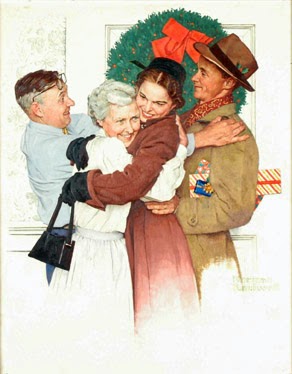
Home for Christmas | Norman Rockwell
By Mary C. Tillotson

Christmas was crazy at my parents’ house, and I missed all of it.

We drove past my hometown (southern Michigan) to visit Luke’s parents (northern Michigan) first, and for a while, the weather was pretty crummy for driving. In northern Michigan, everything just froze, so it snowed and it was gorgeous; in southern Michigan, it was just enough warmer to do a little thawing and refreezing, resulting in an equally gorgeous ice storm that knocked everybody’s power out.

So while Luke and I went ice-skating and wandering around the gorgeous lakefront downtown in crisp winter weather, my parents hosted a houseful of four of their adult children(-in-law), and two of their toddler grandchildren with no power – which meant no heat in the single-digit temperatures, no water except what was manually hauled from the basement sump pump to flush the toilet with (not drinkable). I wasn’t there to help. We live in a day’s drive away, so between work schedules and carpooling arrangements, our travel plans were set when they were set.

Friday, January 10, 2014

Waiting for the Morning

By Joy Pullmann

I wanted to post this during Advent, when I was thinking it constantly, but I couldn't. During Advent, I was holding a newborn all day and night, and wishing desperately for some sleep. Any sleep. (I would still like more, but six hours a night broken by nursing is better than four broken by hours of fussing.)

Our second son was born December 5, and quickly revealed he would have the same tummy troubles as his two older siblings. This meant hours and hours a day of fussy sleep, where baby sleeps for five minutes in between squirms while mom and dad can't because he's squirming every five minutes. So I spent hours staring bleary-eyed out our bedroom window, holding a wiggly baby and waiting for dawn. I'd repeatedly check the time not to see how long baby had slept but to see how long it was until it was finally day and I didn't have to pretend I might get some sleep any more.

Advent, like Lent before Easter, is a time of sober reflection and preparation. New year resolutions and post-holiday housecleaning faintly resemble these two religious seasons. They are supposed to remind Christians that our eternal home is not this world, and that we await Christ's final return, when suffering will, at last, end.

Boy, did I feel that in my sleep-bereft state. A severe lack of sleep has always made me very melancholy. In college I used to cry every Friday night simply because I was so exhausted by the end of the week. This seems like a good setup for sober reflection, but it was hard to reflect on anything except how much I wanted to lie down.

This rotten experience did, however, reveal to me more about the reality of what it means to wait for a perfect eternity. I typically like this world. I have a good life. We're not poor, hungry, persecuted, or isolated. So why would I look forward to the end of it? Why bother with change when the present isn't that bad?

But when your newborn child is suffering, and so are you, this world gets a lot less attractive. It made me yearn, once again, for suffering to end. Some day, it will.

Image by Jan de Graaf, with no changes.

Monday, January 6, 2014

Don't Forget About The Dads

By Ashley McGuire
Institute for Family Studies

Image by David Goehring
During the Christmas season, much attention is given to the mother and child relationship. Christmas cards depict a thousand variations of Mary holding the baby Jesus, hymns tell of virgin and babe, and crèche spotlights in towns across America shine brightly on a woman cradling a baby. It’s a rare few weeks where motherhood is glorified and praised.

But what about Joseph? How does dad fit into the picture?

That ancient question is as relevant as ever, as a government-sponsored study released last week reveals that the role of fathers continues to evolve.

Just as we don’t hear much about the role of Joseph in the Christmas story, these days we don’t hear a lot about what dads have to offer. We hear constantly about motherhood. The mommy wars, the work-motherhood balancing act, the rise of single motherhood. But it’s foolish to try to resolve the struggles moms face without analyzing the role of fathers. Dads are as important in the life of a child as moms, and moms will struggle to flourish without good dads at their sides.

Thankfully, Friday’s study has good news: Fathers are increasingly involved at home and in the lives of their children.

The AP called the study “myth-busting” with regards to the notion that dads don’t pitch in at home, and studied how much time men say they spend doing things like changing diapers and giving baths, reading books and helping with homework, or feeding meals to their children. The study found that father have become increasingly hands-on in the past ten years, and it confirms other studies that find active fatherhood to be on the rise across demographics.

One stand-out detail: Fathers living with their children are far more involved in the daily lives of their children than their non-cohabitating counterparts. And involved fatherhood directly correlates with fewer behavioral problems, better physical health, and better academic performance in children. This all seems somewhat obvious, yet the study found that even as paternal involvement between cohabitating fathers and children is on the rise, father-child cohabitation is on the decline.

So women should take note: If you want an involved father, stay married to him. If you want a better chance for your children, marry their father. And if you want a partner helping to shoulder the burden at home, get married and stay married. Considering that the overwhelming majority of divorces among college-educated couples are initiated by women, it’s worth making this point.

So while it’s sometimes easy to forget about Joseph, this Christmas is a good opportunity to thank and encourage a dad. Men aren’t perfect, and many of them could probably do more at home. But women aren’t perfect either, and sometimes we are prone to overlooking men’s domestic contributions or undermining them when they try to help.

But it’s good for humanity if hands-on fatherhood is “in.” We can all do our part to keep encouraging a trend that helps men, women, and children live happier and healthier lives.

This article was originally published at Institute for Family Studies and is reprinted with permission.

Friday, November 29, 2013

A Complainer Meets Sorrow, and Gives Thanks

By Joy Pullmann

I complain a lot about pregnancy (if you haven't noticed). I whine about how fat I am, and uncomfortable in myriad minor ways. But a few weeks ago, something made me sick of myself. It was a friends' funeral for their unborn child.

Their son died at about 19 weeks old. There is never very much to say about funerals. Thankfully, it was a Christian funeral and family, so grief in that case can be temporary. And I do not like to use other people's stories and sorrow as a morality tale—too much talk cheapens grief—but the little boy's death did make me realize how foolish I am. I complain frequently and crankily about a perfectly normal pregnancy (at least, as far as we know) while another woman and friend would give her right hand to have her little boy still kicking her ribs out. A commenter made a similar point a few weeks ago on one of my rants. And she was right.

My 14-year-old brother died in a car accident on my 19th birthday. Because of that, I sometimes look at my precious children and wonder if one of them will die before me. Or, worse, I wonder if one of them will not join me in heaven. There's no way for me to know, and it's not helpful to sit there morosely thinking of all the evil that may happen. Instead, I try to be thankful for what we do have, which is a great deal. One of them is this tiny little child inside, whose irritations to me mean he is not dead.

Image by The Bywaters.

Wednesday, October 23, 2013

Working from Home: 15 tips from 4 friends

By Mary C. Tillotson

our backyard neighbor!
My husband spent four days in Vermont this summer, and during that time I called some girls at the nearby college to see if we could hang out in the evening -- till then, I'd had more face time with bears than human beings that day and it was disconcerting.

Working from home is awesome but, like anything, it presents its own set of challenges. I emailed three friends (including Joy from this blog and Laura who's written for us a couple times) for their work-from-home tips, and included mine as well. Feel free to add yours in the comments below!

Keeping focused

1. Don't stay in your pajamas all morning and half the afternoon on a regular basis. It might be comfortable, but it will make you feel lazy and unproductive. And not like the functioning, mature professional that you're trying to be. Anna Sutherland

2. Set work hours. I work from 9 (or whenever I wake up, really) until 5, with a lunch break. If I just worked whenever, I would never get done what I need. But if I didn't have an end time, I would hate my job because I would work constantly. Joy Pullmann
via Wikimedia Commons

3. If you have trouble staying focused, as I do, pray specifically for diligence.  I find this helps. Also, I have a picture of St. Thomas More (patron saint of lawyers) hanging right above my desk. His stern gaze can help me stop dilly dallying and get back to work. Laura Christine

4. Make an effort to be friendly with your co-workers, over phone or email. Talking shop with others in your profession helps you stay focused and develop yourself professionally. Build relationships that you can easily share ideas over. Mary C. Tillotson

Not Going Crazy

5. Don't let inertia keep you from leaving the house. If you work from home all day, going places suddenly seems like a significant undertaking (even if it's just the grocery store). And if the only people you regularly see are your family members, going somewhere to (gasp) socialize feels even more daunting.... so you might as well just stay home, you tell yourself. In reality, you do need a change of surroundings and some new company every now and then, so don't hesitate to go to the library, the coffeeshop, the gym, that church event you meant to attend, whatever. Anna Sutherland

6. Don't work an hour before bed. Staring at a computer messes up your sleep patterns. Joy Pullmann

7. Take a walk. If you need a break, get up and go outside for a while.  It helps clear your mind much better than checking Facebook or browsing the web.  In the same vein, consider taking an actual lunch break instead of eating at your desk. Laura Christine

8. Know yourself and your social needs. I'm sure your husband is awesome, but if he's the only human being you see all day (especially if you're extroverted), join a club or take a class or do something outside your home on a regular basis. This will take time away from work and family, but it'll make you happier and more emotionally equipped to be good at all the things you're doing. Mary C. Tillotson

9. Consider a standing desk, or some other way of working while standing. Sitting all day is all kinds of unhealthy.  My husband has set up his computer monitors so that they slide up and down, and he can work part of the day standing up.  He finds he actually has more energy and concentration that way.  I'm working on a way to prop up my laptop so that I can do the same. Laura Christine

Parenting and Family

10. If your kids are older than 1 year old, you need childcare for them, unless you're only working part-time. Under 1 can stay with mommy and is not much trouble, but after they start walking and stop nursing you're hosed. Joy Pullmann

11. In that vein, schedule phone calls. I love having my kids around me, but I can't make calls knowing someone might randomly start screaming while I'm on the phone. Joy Pullmann

12. Make a deliberate decision about the lines between work and family, don't just let it fall where it falls. I don't mind taking some breaks during the day (either I'm distracted by the internet, or I need to go outside, or I wash dishes or update our family budget) and doing some work in the evening, but I might do it differently if I had kids. There isn't a blanket right or wrong way to do it; the best way for you to manage those lines is going to be whatever will make your family top priority and allow you to be professional and hardworking at your job. Mary C. Tillotson

Helpful apps and tools

Waste No Time
13. Get a smartphone. I can work in airports, while the kids are at the library, in the car on the way places, etc. You can get cheap ones and plans at VirginMobile or similar services. Joy Pullmann

14. Waste No Time App: I love this free browser extension!  It allows you to set limits on how much time you spend on a certain website at various times of the day.  For instance, you can set it so that you can only spend 15 minutes on Facebook or Pinterest between the hours of 8 and 5.  You also can block certain sites altogether.  Of course you can cheat and disable the settings, but I find that the screen that pops up when I've gone over my time limit is enough motivation to get back to work. Laura Christine

15. Workflowy is great. I don't even use it that much, because I have to write everything down with a pen, but I can't get over how cool this program is. It's free, just sign in with your email address and a password. (If you want some fun features, you can get them for $5/month.) Workflowy is literally a bunch of bullet points and sub-sub-points and you can zoom in and out and collapse and expand as much as you like. (There's a short video here that gives you a better visual.) For a while I used it to keep track of all my phone calls, so I could know at a glance whether I'd been obnoxious, assertive, or passive about getting ahold of someone. Mary C. Tillotson

If your to-do list is overwhelming and it's hard to get motivated, remember this tidbit from Ray Bradbury: "By doing things, things get done."

What tips do you have for work-from-homers?


Sunday, October 20, 2013

We're Not Confused, We're Married

My husband and I have sort of a strange relationship. I happen to earn our main income and produce all the babies, but he's not one of those lazy-a** husbands who make their wives do all the big jobs while they sit on the couch watching porn or Simpsons reruns. I'm also not the career woman who spends 80 hours a week in the office while her kids languish with a nanny. We're both sort of a weird mixture of the other, unlike both the traditional and sensible husband-wife relationship where the man is the hunter-gatherer and the woman the homemaker, and the modern relationship where everyone works while outsourcing the kids to strangers.

My husband is not androgynous or effeminate. He's spent the past two weeks jackhammering and digging out our hideous concrete patio to make way for what I hope will be a nice new brick one. He handles all the home repairs, car maintenance, and financial matters (thank goodness). I'm also not very manly. I'm not the Cinderalla-Barbie-princess sort of girl, but I crochet, and bake bread, and squee at mice. He's also more stern with the children, and I'm a mushball. 

But my husband also does almost all of our grocery shopping and meal creation. I used to, but I got busy and tired being pregnant all the time, so he took it over.

Thursday, October 17, 2013

Want More Babies? Stop Needlessly Terrifying Pregnant Women

By Carrie Lukas
Culture of Alarmism

Western democracies face a growing problem. No, it's not the ballooning budget deficits, swelling entitlement programs, or expanding ranks of the permanently unemployed. This time the problem is what's not growing: Too few women are having babies to sustain the population.

European countries have long posted fertility rates far below 2.1 births per woman, the level required to replace the population absent immigration. The United Kingdom and France have relatively healthy rates of around 2 births per woman, but Germany, Italy, Spain, Greece, Hungary, Poland, and Austria all have fewer than 1.5 births per woman. The United States had been an exception in the Western world, but the fertility rate recently dipped to 1.9 births per woman.

Low fertility has enormous economic implications. Too few babies today means too few workers and taxpayers tomorrow, and a stagnant economy. World leaders know this, so have tried a range of policies, from tax breaks and cash payments to subsidized parental leave and childcare programs, to encourage procreation. Such efforts have had modest, inconsistent impacts.

Here's one idea that Western democracies ought to consider and it won't take a dime from their strained government budgets: Try toning down the alarmism heaped on expectant parents to make pregnancy and parenting more appealing. Sadly, too much of society seeks to scare would-be parents into believing that danger lurks around every corner for any child they foolishly bring into this toxic world.

Tuesday, October 1, 2013

A Community Is Better than Experts

By Joy Pullmann

My three-year-old son learned a new word this week: Proud. I told him for the first time I was proud of him when he learned to ditch his diapers, all in three days. I'm not sure he understands what the word means--it's an abstract concept, after all, which is why he hasn't heard it before--but it was the best way I could think to express my approval.

My husband actually changes most of the diapers in this house, and makes most of the meals (we havesome role reversal going on because I'm currently the full-time breadwinner), so I wasn't as much relieved to get out of a big chore of mine as tickled pink my little boy managed to figure this out so fast. I mean, he went from peeing in his pants without thinking about it to marching himself to the bathroom at the right impulse, pulling pants down and up himself, doing his business, and cleaning up afterward. That was a lot to learn in six hours. But we haven't had an accident in two days (fingers crossed), and there were a few unintentional ones the two days before that.

Thursday, September 26, 2013

How to help in times of grief

By Tammy Ruiz
Guest Contributor

When Mary asked to wrote a post for this blog, we discussed possible topics and one she floated was the awkward aspects of social relationships after death and how to minimize those. As I am currently living that situation, I thought it was ideal.

I work as a nurse caring for women and families after pregnancy loss and infant death. I spend time with each mom talking to her about how to reenter her previous social relationships. While different deaths create different dynamics, it's good for those around us to peek into our worlds. I may write about the bereaved moms I care about in another post but I want to share something from personal experience today.

I am a 48-year-old Catholic mom and nurse. One year and a few weeks ago I had a bustling house with seven people in it ... I got up on a Saturday morning ready to run to the store to get my husband some soda - he hadn't felt well the night before (he thought he had the flu) and opted to sleep in the theater room lest he get anyone else sick. I went to check on him only to find him dead on the floor. He was young and seemingly very healthy...he was a recently retired Marine Officer who had run marathons - his death was a huge shock.
Tammy Ruiz at her husband's funeral


Because of my work, death was not totally foreign to me, but (of course) nothing prepares you for a life change this profound. In the immediate aftermath of his death, I was so touched by the outpouring of kindness...but even when experiencing it myself, I considered "What parts of this are helpful, what am I really looking for from people?" because I wanted to be able to share what I learned at some point. One day - in the midst of card /flower/fruit basket madness - I realized that as much as I really appreciated each kind gesture, my most primitive need was to know that 1) people had heard the news and 2) it was important to them.

Yes, when the rubber really met the road, I just really wanted to know that my loss was important - whether people expressed themselves grandly or simply, I really did want to hear from them. Even though I would have liked to talk to everyone on the phone, I certainly didn't have time or emotional energy for it, so receiving a combination of cards and calls was ideal. I hardly read the preprinted text of cards, I just wanted to see who wrote it and if they added anything...it could have been a Congratulations on your Bar Mitzvah card for all I knew (one goofy friend did send one of those and it made me laugh). I found it most comforting when people told me that I had been on their mind ever since they heard the news. It was very encouraging to know I hadn't been forgotten.

One last comment about gestures of kindness...in tough economic times, many people have significant financial challenges and there is no shame in it. Please don't feel obligated to do more than you can afford. I received a few gestures that were so sacrificial they were like the widow's pence...while they warmed my heart, they also broke it as I was very concerned that my friends would suffer from it. Your prayers and words of kindness will be treasured by those who really care about you - please don't spend your Cheerios money on flowers.

There were a few people who I considered myself "close" with who I never heard a word from. The understanding gracious side of me realizes that they may have been afraid or uncertain, but my needy hurting side said "we were friends for 30 years and you couldn't reach out at all? really?" The worst for me was a friend who said NOTHING to me then sent a form letter solicitation asking for funds for a missionary trip. I resisted the urge to tell her exactly what I thought about that; in my state of mind, it wouldn't have been tactful.

Rebuilding came in different stages from "Immediate Crisis" to "Dust Settling Over Chaos" to "Calmer Transition" to "Remaking my Life"; waves of grief sent me back to crisis for short spurts, but mostly I moved forward. In the last few months, I have noticed a trend that I want to share.

Being an integrated person is one of my goals, not compartmentalizing different parts of my life into boxes. I am right now STILL a bereaved widow but ALSO a young(ish sort of) person newly single who has a new relationship. I met my husband when I was a teen and we were grandparents when he died - he will ALWAYS be a part of my life...his death will ALWAYS be profound to me. If I waited until those things were no longer factors to fully create a new life for myself, I would wait forever and I have decided not to do that.

I get an overwhelming sense from people that they are willing to talk to me about EITHER my old life and grief OR they want to talk to me about my new life, but few people are willing to do both. For me the most painful example of this was at a social gathering where I sat in a group of five, two married couples and me. Awkwardly, they began to share stories of their courtships and marriages and I felt like a big sore thumb...if I want to participate, do I refer to my former marriage or new romance either of which will make them uncomfortable. I went for the 'new romance' and I got a death-stare multiplied by 4. The flip side of that experience was a coworker who dodged behind doors to avoid me after Dave died yet as soon as I started dating she approached me all full of encouragement and congratulations.

I have come to really value the few people who are brave enough to let me really be myself...a person who is just as likely to cry over a memory as I am to gush over a rose from my boyfriend. Maybe to some folks, absorbing the fact that both of these factors are (and will remain for the foreseeable future) real to me seems terribly weird. Yes it is, but let me assure you, when your spouse dies suddenly and young, a LOT of things are weird. To this day I use words that I can still barely believe apply to me even as they flow from my tongue "single mom," "widow," "late-husband," "estate, "girlfriend/boyfriend." (I really need new terms for this...my "boyfriend" is a military Colonel and Special Agent...I feel silly using this to describe him.)

If you have a friend going through this and really want to be there for her (or him), be a person who does not put up the walls I so frequently perceive ...let them be real and whole even when that means you aren't sure what the heck will come out of them next. If you are reading this and it terrifies you because you can't imagine your husband dying suddenly, while I will tell you that yes, it IS horrible, God won't leave you to experience it alone...He will be close in a thousand ways that you can be thankful for (like NOT having told my daughter to "go check on your dad") and He won't leave you to suffer alone.

Tammy Ruiz has been a nurse for 28 years and spent most of her career in Neonatal Intensive Care. For eight years, she has been a Perinatal Bereavement Coordinator - caring for women and families suffering miscarriage, stillbirth, neonatal death and SIDS. Part of her work involves assisting parents in preparing for births when the baby has received the diagnosis of a life limiting condition (often called "Perinatal Hospice"). In addition to her nursing education, she studied (but did not become certified in) Clinical Pastoral Education at a Catholic Hospital in the Midwest. She has been on EWTN and speaks regularly to physicians and nurses on the topic of perinatal loss care. Her career was both fragmented and enhanced by having 14 different jobs because of moves for her husband who was an active duty Officer in the USMC. A convert to the Catholic Church, she was recently widowed after 26 years of marriage. She has three quasi-adult children and one super-cute grandchild.